Ten Things One Needs to Know about the Provincial Procurators to Rome
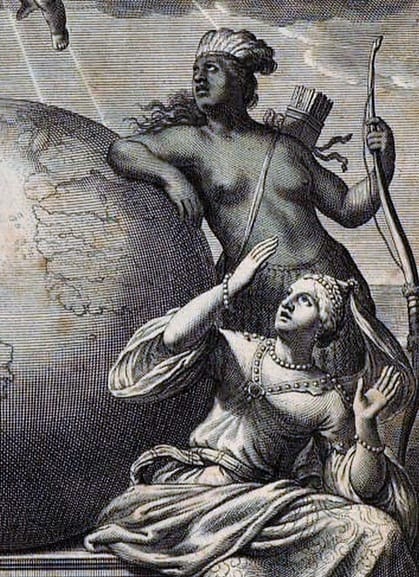
Imagen: Imago primi saeculi Societatis Iesu a Prouincia Flandro-Belgica euisdem Societatis repreasentata (detalle del emblema “Unus non sufficit orbis” (Un mundo no es suficiente) Amberes, Ex officina Plantiniana Balthasaris Moreti, 1640.
In this first blog entry, we offer an introduction to the main ideas one must be familiar with in order to approach the principal object of study of the ProJesArt Project: Jesuit provincial procurators and their involvement with material and artistic culture in the Early Modern Age. At the end, a basic bibliography is included. Further texts by members of the project are listed in the “Publications” section of this web page.
ONE. DEFINITION OF THE POST
The provincial procurators (procurator provinciae) were appointed every three years (sometimes six) to report on the affairs of their respective provinces to the highest authority of the order in Rome, the General, and to attend (if they coincided) the Congregations of the Society of Jesus. Sometimes the periodicity was not fulfilled due to various problems: in the case of the Americas, there could be economic obstacles to procurator mobility leading to the decision by some territories to delegate in other provinces; there were often also logistical problems, related to fleets, shipwrecks, etc.
TWO. PRIORITIES IN AMERICA AND THE PHILIPPINES
The procurators who came from the Jesuit provinces of America, including the Philippines, had an additional priority during their sojourns: to recruit missionaries and accompany them on the return trip. However, not all provincial procurators ended up returning to their original locations; some stayed in Spain to occupy other positions, such as Procurator General in Madrid or Procurator General of the Indies in Seville.
THREE. DISTINGUISHING BETWEEN THESE “PROCURATORS” AND OTHERS
Within the Society of Jesus, the provincial procurators (to Rome) are a position distinct from the Jesuit procurators who worked on a local scale in all their institutions, managing the affairs of the colleges, seminaries, churches, and estates (such as the haciendas, estancias, or obrajes). It is also a different position than other special procurators appointed by the order at different times and places, such as the Procurator General in Madrid (liaison of the Jesuits at court), and the Procurator General of the Indies in Seville. The office of the latter was founded to facilitate the task of the procurators from the provinces of America and assist in organizing the transfer of missionaries from Europe abroad (on the subject, see A. Galán García in the bibliography).
FOUR. PROFILE
These procurators were usually very capable Jesuits who had demonstrated their ability to deal with complex organizational tasks in previous occupations. They were also thoroughly knowledgeable about the specific needs of their province. All were professed Jesuits who had taken the four-vows. They were usually accompanied on their journey by a coadjutor (lay brother) who assisted them.
FIVE. INSTRUCTIONS
Prior to the trip, the highest Jesuit authority in each Province, the Provincials, issued Instructions to the procurators. Certain instructions were recurrent from one Provincial to the next, especially that they should make sure to obtain the necessary travel licenses from the Spanish authorities to travel to Rome from Spain, as well as to transfer missionaries.
SIX. THE ACQUISITION OF OBJECTS ON THEIR TRAVELS
Another of the instructions was that they should acquire “things of devotion”, sometimes specifying rosaries, crucifixes, prints, medals and more, which were to be obtained in Rome. The purchases of this nature were extended to other geographies in the itinerary of their trip, including devotional objects from various sanctuaries they visited on their journey (Montserrat and Loreto) as well as other types of objects (such as sculpture in Naples). The “things of devotion” that traveled with the procurators were exempt from taxation because they were of devotional use and considered necessary for the missions.
SEVEN. PETITIONS FROM THIRD PARTIES
The Jesuits’ return crates also included some things that were NOT of a religious nature and that had been acquired in response to specific petitions the procurators had received from third parties in their places of origin before departing. The objects they purchased for third parties included devotional objects as well as books, clocks, rich fabrics such as silks, brocades, and velvets and other fashionable objects. They also accepted commissions from these third parties of an administrative nature, leading the procurators to mediate in Europe in various affairs: depositing money for relatives, requesting a license for a private oratory, settling a debt, depositing alms in specific churches, chapels, or congregations, and more.
EIGHT. THE VOYAGE AND THE SCOPE OF THIS STUDY
The figure of the Jesuit procurator offers a window into the history of travel in the Modern Age with many possibilities for study (cultural, material, economic, political, social, religious and art historical). For the history of the American viceroyalties, these transfers are special because the procurators were among the most frequent travelers to Europe and very few residents in America had the possibility of making this transatlantic and Mediterranean round trip. Moreover, in the context of the history of the Hispanic world and its inter-territorial relations, it is a singular trip because it was not only about connecting America with Spain: rather, the objective was to reach Rome and, on the way, the Jesuit procurators passed through many other European geographies.
NINE. SOURCES
The documentation related to the activity of these Jesuit procurators found in archives around the world is very rich in information and still awaits further exploration. It includes instructions, much correspondence (which provides a glimpse into the true modus operandi of the procurators and how they negotiated the regulations and expectations of the period), registers of petitions, travel books, accounting records, and more.
TEN. THE CURRENT STATE OF KNOWLEDGE
In spite of the very extensive and rich historiography on the Society of Jesus world
Luisa Elena Alcala, “10 preguntas preliminares… en torno a los objetos viajeros y los procuradores jesuitas”, en Blog ProJesArt, febrero 2023 [https://projesart.org/blog/ ]
Bibliografía introductoria al tema:
ALCALÁ, Luisa Elena. “De compras por Europa”: procuradores jesuitas y cultura material en Nueva España,” Goya. Revista de Arte 318 (2007): 141–158.
COELLO, Alexandre y Fabian FECHNER (eds.). Political Agents and Cultural Mediators: Jesuit Procurators in a Globalizing World (16th and 18th centuries). Manuscrito en preparación.
GALÁN GARCÍA, A. El “Oficio de Indias” de Sevilla y la organización económica y misional de la Compañía de Jesús (1566-1767). Sevilla 1995.
GRAMATKE, Corinna. “‘La portatil Europa’. Der Beitrag der Jesuiten zum materiellen
Kulturtransfer”. Erwin EMMERLING y Corinna GRAMATKE (eds.), Die polychromen Holzskulpturen der jesuitischen Reduktionen in Paracuaria, 1609-1767. Kunsttechnologische Untersuchungen unter Berucksichtigung des Beitrags deutscher Jesuiten. Munchen: Technische Universitat Munchen, 2019. 191-397.
MALDAVSKY, Aliocha. “Conectando territorios y sociedades. La movilidad de los misioneros jesuitas en el mundo ibérico (siglos XVI-XVIII),” Historica 38:2 (2014): 71-109.
MARTÍNEZ SERNA, J. G. “Procurators and the Making of the Jesuits´s Atlantic Network”, en Soundings in Atlantic History. Latent Structures and Intellectual Currents, 1500-1830. Cambridge 2011.
SCOCCHERA, Vanina. “Que el procurador lo pase a mis manos: encargos de devoción y embargos temporales en el navío San Fernando (Río de la Plata, 1767)”. Temas Americanistas, 48 (28 de junio de 2022): 474-506.
ZUBILLAGA, F. (S.J.). “El procurador de Indias Occidentales de la Compañía de Jesús”, Archivum Historicum Societatis Iesu 22/43 (1953): 367-417.
ZUBILLAGA, F. (S.J.). “El Procurador de la Compañía de Jesús en la corte de España (1570),” Archivum Historicum Societatis Iesu 16 (1947): 1-55.